Most of what I know about business, I learned from the inside.
I've sold an $800 million property, helped build a company that was weeks from growing fivefold, and watched most of it burn in one night. Now I help small business owners build the kind of business that holds.
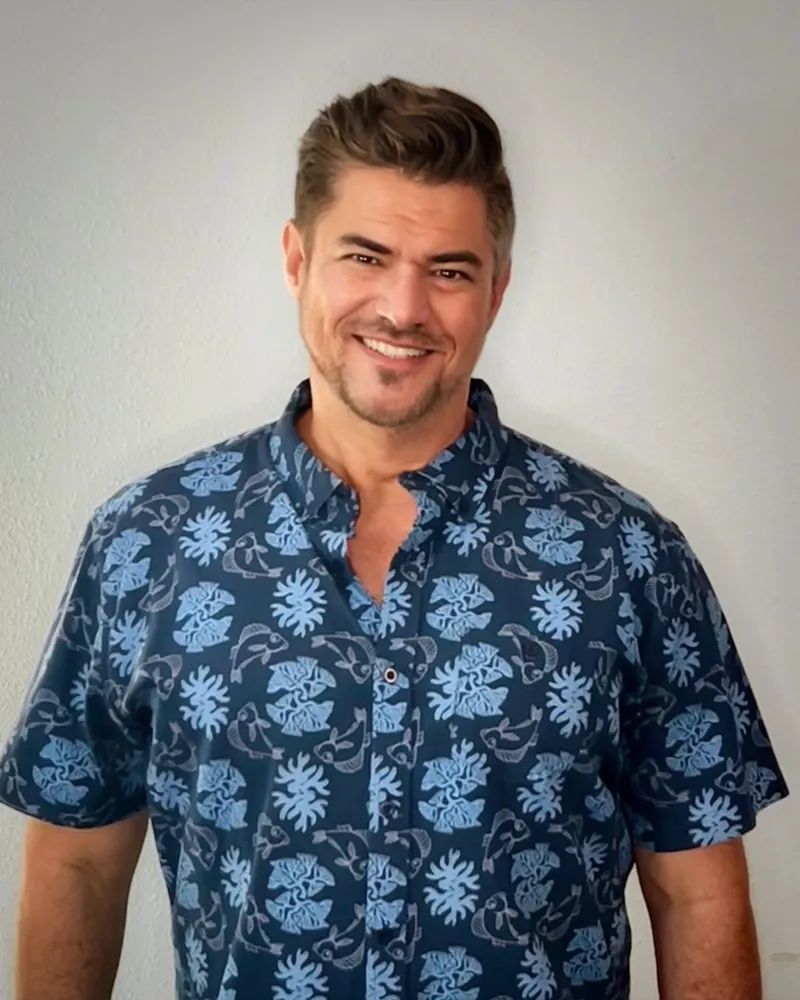
I spent eleven years with Ritz-Carlton. Eight of them were at Kapalua Bay, as Director of Sales & Marketing on an $800 million residential property. What we were really selling was the whole Ritz-Carlton experience built into private ownership, and that took a different kind of sales team and a much higher standard. It's where I learned what billion-dollar discipline looks like: pricing you can defend, systems that don't depend on one person, and a standard that holds on a bad day.
When the property sold, I followed my heart into working with small business owners. I wanted to put that kind of thinking in the hands of people who almost never get access to it.
Along the way I was a consultant and hands-on partner to what's now the most respected event and DJ company on Maui. Relationships, events, the referral network, the reputation. All of it built from the inside.
Then an investment group in Lahaina brought me in to work across its seven businesses. After 90 days they put me on payroll, working right alongside the owner. Marketing, customer experience, culture, the team. We were on track to grow from 50 people to 250, launching three new businesses within a year of each other. The general store opened. The two restaurants were permitted, staffed and weeks from opening.
On August 8, 2023, the fire took five of the seven in one night. Both restaurants. The main offices. Most of what we'd built. The two that survived were hit next by the collapse of Maui's tourism economy.
Rebuilding after that taught me what the Ritz never had to. Which parts of a business hold when everything else goes. Why the numbers have to be clear before the pressure arrives, because there is no time to learn them after. That's where the diagnostic-first way I work comes from.
I'm two and a half years into my own rebuild. In it, not through it. I think it makes me better at this work.
Start it right. Grow it profitably. Sell it for what it's worth.
For most of PSS's life I helped owners in the middle of the story: a business that's running, growing, and not paying them what it should. That's still the core of what I do.
The plan was always the whole arc. A business rarely fails in the middle of a good quarter. It fails at the turns, where what worked last year quietly stops working before anyone notices. About half of new businesses don't make it five years, and most of that happens right there. I wanted to be there for all of the turns.
So now I start at the beginning, and I love this part. Somebody with some savings and an idea, and we build the numbers, the offer and the price before they spend a dollar they didn't need to.
The middle is what PSS has always done. Find the profit, fix the structure, make the growth pay.
And the end is what the whole thing points at from day one. Launch Acceleration, Growth Acceleration and Exit Acceleration all run on one method, the Profit Acceleration Operating System, because a business's problems at the start, the middle and the end are closer than they look. Getting the market position right at the beginning is the same work as defending it later, which is the same work as proving it to a buyer at the end.
Build it so you could sell it for top dollar. Then decide you don't want to.
The map I use for every business
Every business moves through stages, and each one asks something different of its owner. The best map I've found for that comes from Les McKeown's Predictable Success model.
Predictable Success Systems was already the foundation of my consulting business when Scale Architects approached me. The fit was so natural that I went through their training, learned the framework in depth, and worked as a Scale Architect for a time. I still find it one of the clearest ways to see where a business stands and what the next stage will ask of it.
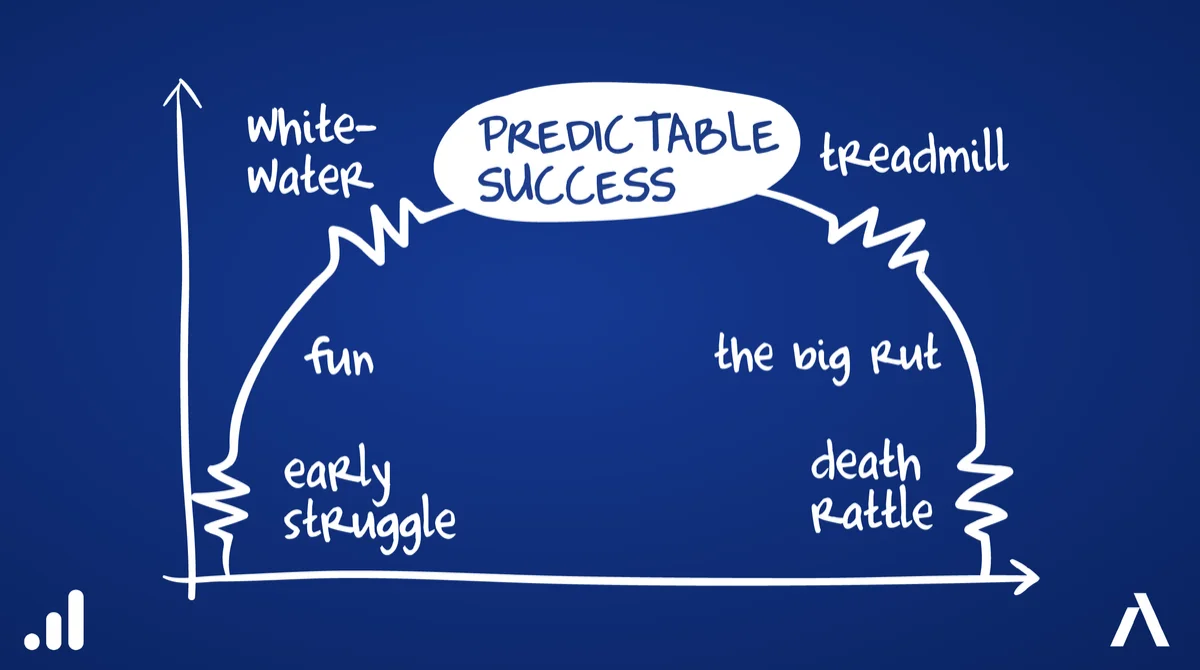
It fits the three ways I work almost perfectly. Launch Acceleration is built for Early Struggle, so you get through it with the math already in place. Growth Acceleration is for Fun and Whitewater, where most of the owners I work with live: sales growing, the team growing, and everything getting harder instead of easier. Exit Acceleration works toward Predictable Success too, because that's where a business runs without its owner and is worth the most to a buyer. Some owners get there climbing out of Whitewater. Many come from the other side: the business has slid past its peak, and that's the real reason they want out. Then we run the lifecycle in reverse, with the same system, back to the top. More often than you'd think, once the business runs well again, the owner decides not to sell. If they still want out, they sell from the top instead of the slide.
Most of the small business owners I talk to aren't stuck because they're doing the wrong things. They're stuck because they're doing the right things for the wrong stage. Knowing the stage tells us what to fix first.
My thanks to Les McKeown, and to Scott Ritzheimer of Scale Architects, for this framework and for their part in my own journey.
How I work
The first reason is the Ritz. I watched what real systems and real discipline can do, and most small business owners never get anywhere near that kind of thinking. I want to hand it to them.
The second is a moment I get to see over and over. An owner who's been grinding for years, missing time with family, wondering why they left a job just to become an employee of their own business, finally sees the plan working.
The stress drains from their face. The spark comes back. They breathe for the first time in maybe years.
Business is supposed to be fun. If it isn't, the way back is almost always structural, and it's almost always fixable.
The part most business plans leave out
A business can't be healthier than the person running it.
So I schedule myself first. Time for my body, my mind and my spirit goes on the calendar before the work does, and the work gets built around the life I want to live. Most owners do it in the opposite order, and then wonder why the business feels so heavy.
I don't keep business and spirit in separate boxes. Love, money, health and spirit are all expressions of the same alignment, and when one is out of line the others feel it. A business that pays you well and costs you your health or your family isn't finished yet.
So part of the work, at every door, is building a business that fits your life. Your hours, your pace, and the things that matter to you outside of it. That's what the business is for.
Wherever your business is, start there.
Virtual coffee over Zoom. No pressure either way.